
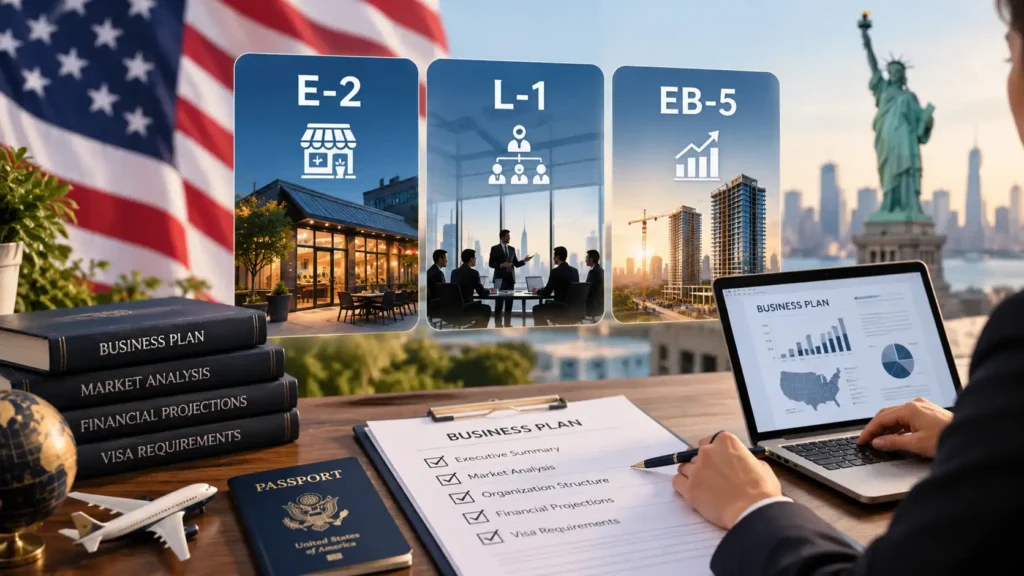
Three visas. Three different officers. Three different definitions of a “good” business plan.
An E-2 plan convinces a consular officer that your investment is real and not marginal. An L-1 plan convinces USCIS that a new U.S. office can support a manager within a year. An EB-5 plan must satisfy a decades-old precedent that demands enough detail for the officer to draw reasonable conclusions about job creation.
Use the wrong format and you fail the test that matters. This guide breaks down what each plan must prove, how they differ, and how to choose.
Quick Comparison: E-2 vs L-1 vs EB-5
| Factor | E-2 Treaty Investor | L-1A Intracompany Transferee (New Office) | EB-5 Immigrant Investor |
| Visa type | Nonimmigrant | Nonimmigrant | Immigrant (green card) |
| Who qualifies | Nationals of treaty countries | Managers or executives of a foreign company | Any nationality |
| Minimum investment | None fixed, must be substantial | None, but parent must fund the office | $800,000 (TEA) or $1,050,000 |
| Job creation | Must not be marginal | Must support managerial role | 10 full-time U.S. jobs per investor |
| Initial duration | Up to 5-year visa, 2-year admissions | 1 year for new office | 2-year conditional green card |
| Path to green card | No direct path | Yes, often via EB-1C | Yes |
| Decision maker | Consulate or USCIS | USCIS | USCIS |
| Projection horizon | 5 years | 1 to 3 years, year one in detail | 5 years minimum |
Each visa also has a different relationship with business plan length and depth. For a deeper E-2 and EB-5 comparison, see our guide on key differences between E-2 and EB-5.
E-2 Visa Business Plan Requirements
What the Plan Must Prove
- The investor is a national of a treaty country and owns at least 50%
- The investment is substantial, at risk, and from a lawful source
- The business is real and operating
- The business is not marginal, meaning it will produce more than a living for the investor’s family
- The investor will develop and direct the enterprise
What Officers Check Most
Hiring plans and source of funds. A consulting firm with a single owner and no hiring schedule is the classic refusal. If you are new to the category, start with how the E-2 treaty investor visa works.
Recommended Length
20 to 35 pages, plus exhibits. Consulates often set package limits, so tight writing matters more than volume.
L-1A New Office Business Plan Requirements
What the Plan Must Prove
- A qualifying relationship between the foreign company and the U.S. entity (parent, subsidiary, branch, or affiliate)
- The transferee worked for the foreign company for at least one continuous year in the past three, in a managerial or executive role
- The U.S. office has secured physical premises
- Within one year, the U.S. office will support an executive or managerial position
- The foreign parent can fund the U.S. operation
What USCIS Checks Most
The organizational chart. USCIS wants to see that the transferee will manage people or a function, not do the daily work. If year one shows the manager answering phones and making sales calls, expect a Request for Evidence.
Virtual offices and mail-forwarding addresses rarely satisfy the premises requirement.
The Extension Problem
The new office L-1A starts with one year. At extension, USCIS compares the plan to reality. If you projected six hires and made two, the extension is at risk. Write year one conservatively.
Our L-1 visa business plan service is built around this one-year test. You can review an L-1 visa business plan sample to see the structure.
Recommended Length
20 to 30 pages, with a strong organizational chart and a 12 to 36 month staffing plan.
EB-5 Business Plan Requirements
What the Plan Must Prove
Under the precedent set in Matter of Ho, an EB-5 business plan must be “comprehensive” and credible. That means:
- A description of the business, its products or services, and objectives
- A market analysis with named competitor types and target customers
- Evidence of required permits and licenses
- A detailed timeline for hiring and operations
- Organizational structure and personnel qualifications
- Staffing timetable with job descriptions for every position
- Sales, cost, and income projections with the basis for each
Investment and Jobs
| Item | Requirement |
| Investment in Targeted Employment Area | $800,000 |
| Standard investment | $1,050,000 |
| Jobs per investor | 10 full-time positions for qualifying U.S. workers |
| Direct EB-5 job counting | Direct W-2 employees only |
| Regional Center job counting | Direct, indirect, and induced jobs through economic models |

2026 and 2027 Timing to Watch
The Regional Center Program is authorized through 30 September 2027. Petitions filed by 30 September 2026 received grandfathering protection. Investment amounts are scheduled for an inflation adjustment on 1 January 2027, with DHS announcing the final figures.
With the grandfathering window closed, more investors are turning to direct EB-5 projects. Our analysis of why direct investment plans now carry the weight explains the shift.
Recommended Length
40 to 60 pages plus exhibits, with job creation tables tied to payroll.
Side-by-Side: Business Plan Section Differences
| Plan Section | E-2 | L-1A New Office | EB-5 |
| Executive summary focus | Investment and non-marginality | Corporate relationship and managerial role | Investment, jobs, and timeline |
| Ownership section | Treaty nationality and 50%+ control | Parent-subsidiary documentation | Investor’s equity and capital at risk |
| Source of funds | Detailed trail in plan or exhibits | Parent company funding capacity | Exhaustive trail, often in separate exhibits |
| Hiring plan | 5 years, roles and wages | Year one staffing that frees the manager | 10 jobs per investor, timeline and job descriptions |
| Market analysis | Local, practical | U.S. market entry and parent’s advantages | Comprehensive, with cited data |
| Financial projections | 5 years | 1 to 3 years, year one by month or quarter | 5 years, tied to job creation |
| Org chart | Helpful | Critical | Required |
| Biggest failure point | Marginality | Manager doing operational work | Job creation not credible |
Which Visa Plan Fits Your Situation?
Use this decision matrix:
| Your Situation | Best-Fit Visa | Why |
| Treaty country national, $100K to $500K to invest, wants to run a small business | E-2 | Lower capital, fast consular process |
| Executive of an established foreign company opening U.S. operations | L-1A | Corporate route, path to EB-1C green card |
| Any nationality, $800K+ available, wants a green card | EB-5 | Direct path to permanent residence |
| Non-treaty national with under $800K | Neither E-2 nor EB-5 fits; consider L-1 if you own a foreign company | L-1 does not require personal investment |
| Treaty national who wants a green card later | E-2 now, EB-5 later | E-2 plan can support a future EB-5 if it grows |
On the flip side, some investors are also weighing newer routes. Our comparison of Gold Card vs EB-5 vs E-2 explains which routes actually need a business plan.
Cost and Time Comparison
| Factor | E-2 | L-1A | EB-5 |
| Plan preparation time | 2 to 3 weeks | 2 to 3 weeks | 3 to 6 weeks |
| Relative plan complexity | Moderate | Moderate | High |
| Government processing | Weeks to months (consular) | Months, premium processing available | Often years |
| Renewal or follow-up plan | At each renewal | At first extension | I-829 removal of conditions |
For budgeting, see our guide to immigration business plan cost.
Common Mistakes When Reusing a Plan Across Visas
Investors sometimes ask us to “convert” an E-2 plan into an EB-5 plan. It rarely works without a rebuild. Here is why:
- An E-2 plan with four hires falls far short of 10 EB-5 jobs
- L-1 plans focus on corporate structure, which an E-2 officer does not need
- EB-5 plans require job descriptions and a hiring timeline for every position
- Investor business plans written for funding focus on returns, not on immigration tests. See immigration vs investor business plans.
Frequently Asked Questions
Which visa needs the most detailed business plan?
EB-5. Matter of Ho requires a comprehensive plan with enough detail for USCIS to draw reasonable conclusions about job creation.
Can I switch from E-2 to EB-5?
Yes, if you meet the EB-5 investment and job creation rules. Your E-2 business can become the EB-5 enterprise if it grows to 10 qualifying jobs and receives the required capital.
Does an L-1 require a minimum investment?
No. USCIS needs evidence that the foreign company can fund the U.S. office until it supports itself.
How many years of projections do I need for each visa?
E-2: five years. L-1A new office: year one in detail, with one to three years total. EB-5: five years, linked to job creation.
Get the Right Immigration Business Plan
The visa determines the test, and the test determines the plan. Writing an EB-5 plan to E-2 standards, or an L-1 plan without a credible org chart, wastes filing fees and months of time.
BPlanWriter writes immigration business plans for E-2, L-1, and EB-5 applicants. Review our EB-5 business plan sample or explore our EB-5 business plan service, then book a consultation to match your plan to your visa.
This article is general information, not legal advice. Work with a licensed U.S. immigration attorney on your petition.
